Niseko or Hakuba: Where Australians Should Ski Japan First
Australia's season ended early this year, and it ended quietly. Thredbo turned its last lift on Sunday 13 September, about three weeks ahead of schedule. Perisher was down to eleven of its forty-five lifts by early September. Most other resorts had already closed weeks ahead of schedule. On the third of September the snow at Spencers Creek measured thirty-one centimetres — the lowest reading for that date in seventy-three years of records — after a peak in mid-August that ranks third-lowest since 1954.
So the conversation that usually starts in July started late this year, and it has an edge to it. We're finally doing Japan. But is it Niseko or Hakuba?
It is the right question, asked the wrong way. These are not two versions of the same holiday. They are two different philosophies of winter, separated by eight hundred kilometres, a strait, and a fundamental disagreement about what a ski trip is for. Niseko is a promise about snow. Hakuba is a promise about mountains. Your first Japanese winter depends on which promise you would rather have kept — and this year, unusually, the forecast has something to say about it.
The Snow: A Machine Versus a Theatre
Niseko's reputation rests on arithmetic that borders on the absurd. Storms roll off Siberia, cross the Sea of Japan, gather moisture, and unload on Hokkaido with the reliability of a train timetable — somewhere in the order of fourteen to fifteen metres across a typical season, falling on ninety-plus days. That is not a freak year. That is the long-run average. The snow itself is the lightest regularly skied powder on earth: so dry it squeaks underfoot, so frequent that locals speak of resets rather than snowfalls. Wake, look out the window, and more often than not the mountain has been wiped clean overnight.
Hakuba plays a different game. Tucked under the Northern Japan Alps on Honshu, it receives less — roughly eleven metres in a typical winter — arriving in fewer, bigger performances. When a storm does hit the valley it can be theatrical: half a metre overnight, the Happo ridgeline vanishing into cloud, the whole valley holding its breath. Between storms come the bluebird days Niseko rarely grants, with the three-thousand-metre spine of the Alps standing sharp against the sky.
Here is what is different about this particular winter. A very strong El Niño is in place, and Japan's weather agency expects it to last through the season. Its outlook leans towards a warmer winter, with below-normal snowfall more likely on Honshu's Sea of Japan side. Hokkaido sits further north and is usually less affected, though its outlook is not an especially snowy one either. For valleys like Hakuba and Myoko that tends to mean a little less depth and more clear days. A seasonal outlook shifts the odds; it does not write the season.
Read that carefully, because it cuts both ways. If your single priority is the highest probability of fresh snow on any given morning, a season like this argues harder than usual for Hokkaido. If you are the kind of skier who wants to see where you are going — who wants the ridgeline, the alpine start, the terrain rather than only the surface — Hakuba in a clearer winter has real appeal.
The Mountains: One Volcano Versus Ten Resorts
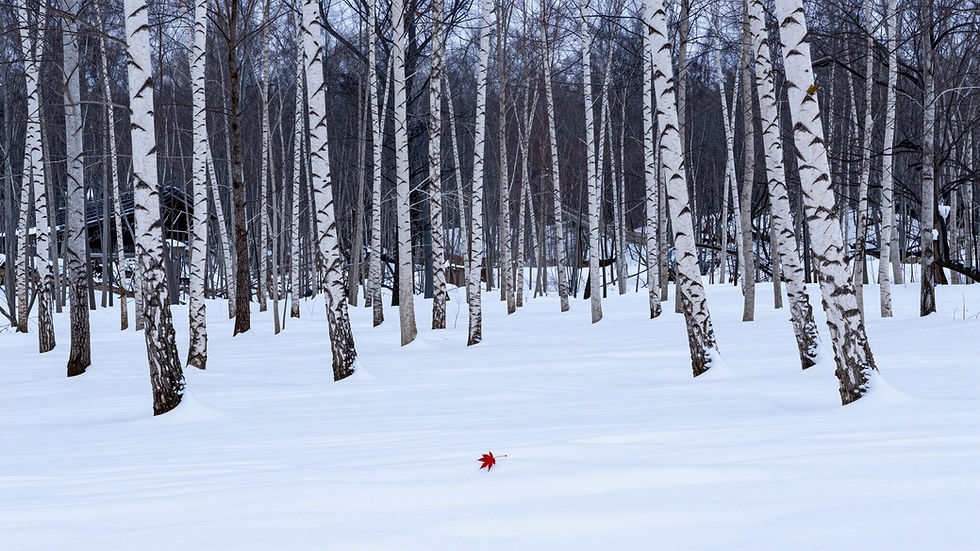
Niseko United is four interlinked resorts — Grand Hirafu, Hanazono, Niseko Village and Annupuri — wrapped around a single volcanic cone, skiable on one pass and genuinely connected at the top. The terrain is rolling, forgiving and tree-lined, with birch glades that may be the most photographed in world skiing. What it lacks is scale and steepness. Strong skiers can exhaust the marked terrain in a few days, which is precisely why the famous backcountry gates — Niseko's controlled system for accessing the sidecountry bowls — matter so much to the experience, and why they should be treated with the seriousness the local patrol treats them.
Hakuba is not one mountain. It is a valley of ten separate resorts strung beneath the Alps: from the Olympic pedigree of Happo-One, which hosted the downhill at the 1998 Nagano Games and offers well over a thousand vertical metres of genuine fall line, to the powder-choked trees of Cortina at the northern end, to family-scaled hills like Tsugaike. No two feel alike. The scale is European, the vertical is among the biggest in Japan, and the steeps are real. Advanced skiers who found Niseko charming but brief tend to find Hakuba consuming.
The honest summary: Niseko is the better snow experience; Hakuba is the better skiing experience. Intermediates and first-time powder skiers will be happier in Niseko's soft, navigable glades. Confident skiers chasing terrain will find Hakuba the deeper well.
The Villages: Izakaya or International
Hirafu, Niseko's main village, has become one of the great international ski towns, and it is unapologetically cosmopolitan. The dining is remarkable for a town its size — proper omakase, serious ramen, wine lists that would embarrass some Sydney establishments. It is also, famously, full of Australians. Whether that is a comfort or precisely what you flew eleven hours to avoid is a personal matter, and worth being honest with yourself about before you book.
The Hakuba Valley sprawls more and polishes less. Echoland and Happo have lively pockets — good izakaya, snug bars, the odd craft brewery — but the valley never quite surrenders its identity as a collection of Japanese farming villages that happen to sit beneath extraordinary mountains. Onsen culture runs deeper. Day-to-day costs run noticeably lower. Dinner is more likely to involve pointing gratefully at a handwritten menu. A good number of travellers find that the more affecting version of Japan.
Getting There: The Direct-Flight Advantage
The calculus has shifted meaningfully for Australians, and it shifted again for this season. Qantas flies non-stop from Sydney to Sapporo's New Chitose Airport — the only direct service between Australia and Hokkaido — and after strong demand the airline has expanded it from three flights a week to as many as five, running 7 December 2026 through 31 March 2027, with the heaviest frequency from mid-December into January. That is a capacity increase of more than fifty per cent and something in the order of ten thousand extra seats.
Land in the early evening and a coach delivers you to the village the same night. Board bags and ski bags fly to a country purpose-built to receive them. Door to door, it is now among the easiest overseas ski transfers on offer anywhere.
Hakuba asks a little more. Fly into Tokyo, take the shinkansen to Nagano — itself part of the pleasure, all speed and silence and mountains gathering in the window — then a valley transfer. Roughly half a day in total. The compensation is Tokyo. A Hakuba trip bookends naturally with days in the capital; a Niseko trip does not. For first-timers who want Japan-the-country as much as Japan-the-snow, that is not a small thing.
The Money
Lift access in both is startling value by Australian standards, even at its most expensive.
Niseko United's all-mountain adult day pass reaches ¥13,500 in the 2026–27 peak window of 24 December to 28 February, roughly A$140 at recent exchange rates. Outside those dates it drops to ¥12,600 in the regular season and steeply lower at the shoulders. The season runs 28 November 2026 to 5 May 2027.
Hakuba Valley's pass covers all ten resorts and starts from around ¥10,400 a day. The valley's all-mountain season pass went on sale in July, and for overseas buyers it is Hakuba Valley's pass covers all ten resorts and costs ¥11,100 a day for adults, the same price all season. Multi-day passes bring that down a little: a fourteen-day pass is ¥148,000. The early-bird price on the valley's season pass ended on 29 October., rising to ¥188,900 after that — a deadline worth knowing about if you are contemplating anything longer than a fortnight.
The real difference is everything around the ticket. Niseko's limited central land and concentration of modern, amenity-rich buildings keep accommodation high, particularly from late December through Lunar New Year, with luxury chalet rates that have drifted toward Aspen territory in peak weeks. Hakuba's wider valley supports a broader spread — budget lodges, mid-range hotels and premium chalets often within the same few streets — and comparable chalet stays commonly land well below the Niseko figure. Over a week for two, the gap can be substantial. That money buys a longer stay, a better room, or the Tokyo leg.
The Verdict: Which First?
Choose Niseko first if this trip is about the snow itself — if you want the highest possible probability of waking to fresh powder on any given morning, the gentlest introduction to skiing it, the simplest logistics from the east coast, and a village where nothing is lost in translation. In a season forecast to run warmer than the last few, Hokkaido is also the more reliable bet for snow cover. It is the right first Japanese winter for intermediates, families, and anyone whose powder experience so far amounts to a lucky Wednesday at Perisher.
Choose Hakuba first if you ski hard and the word terrain quickens your pulse — if you want Japan's biggest verticals, some of its most serious steeps, the Alps on the horizon and Tokyo on the itinerary, at a friendlier daily spend. And if the bluebird pattern holds, this is the winter to see the range you came for rather than guess at it through cloud.
If you cannot choose — good. That is the correct response. Nobody skis Japan once. The only real mistake is trying to squeeze both into a single short trip; they are a flight or a long travel day apart, and each deserves your full week. Pick one promise this winter. The other will keep.
The Line Continues South
One more thought, for readers of this magazine in particular. Japan is among the very few places on earth where the mountain and the ocean genuinely share a season. Chiba's beach breaks and Okinawa's reefs work right through the winter months, and a growing number of Australians are quietly carving both — a week in the powder, then a few days in the water on the way home, board bag and ski bag riding the same shinkansen. Our guide to Japan, where the snow and the sea are the same water maps the whole idea.
If that itinerary tempts you, what belongs in your board bag is a decision worth making months before you fly. And Japan's surf stays are more established, and more bookable, than most visitors expect.
Because the line does not stop at the tree line. It never has.
Some links on this page are affiliate links. If you book through them we may earn a commission, at no extra cost to you. We only recommend experiences and partners we would choose ourselves.


Comments